Generic selectors
Exact matches only
Search in title
Search in content
Post Type Selectors

Level up your fitness journey with MuscleBlaze

MUSCLEBLAZE

What Your Breathing Pattern Does to Your Lifts

Hello Ziddis! Do you think of breathing as just air flow in and out during a lift? Your breathing pattern directly affects intra-abdominal pressure (IAP), spinal stability, oxygen delivery and fatigue management. If we do it the right way, it boosts strength and control. If done wrong, it reduces your strength, destabilises your spine and makes the lifts feel harder than they should. This is what your breathing pattern does to your lifts. 

Diaphragmatic Breathing

Diaphragmatic breathing is how you can breathe the right way for effective lifting mechanics. Instead of lifting the chest or shrugging the shoulder, the diaphragm descends, and the abdomen expands from all sides, front and back.

This matters because when the diaphragm descends and the core muscles brace against it, and when that happens, the intra-abdominal pressure increases. That pressure acts like an internal weight belt, stiffening the spine and allowing force to transfer efficiently from the legs and hips into the bar. Here is what happens:

  • Bracing uses diaphragmatic breathing followed by active abdominal tension. You inhale, expand, then lock that pressure in while lifting.
  • The Valsalva manoeuvre is an extreme version of bracing, which is a deep diaphragmatic breath held briefly against a closed airway. It maximises IAP and spinal stiffness, making it ideal for heavy, low-rep lifts. 
  • Shallow breathing, which means chest-only breathing, fails to pressurise the abdomen.

    In short, the diaphragmatic breathing is what allows bracing and Valsalva to work, and without it, you would just be lifting on a soft core. 

    Diaphragmatic Breathing Exercises

    Diaphragmatic breathing exercises train your ability to generate and control abdominal pressure before applying it under load. Some you could try during your workout are:

    • Supine breathing- Lie on the floor on your back with knees bent. One hand on your chest, one on your belly. Inhale through the nose and expand the belly without the chest rising. Exhale slowly.
    • 90-90 breathing- Feet on a wall, hips and knees at 90 degrees. Inhale deeply into the abdomen and lower rib and then slowly exhale.
    • Breathing with light bracing- Inhale diaphragmatically, then tighten your core as if preparing for a lift, without holding your breath.

      Diaphragmatic Breathing Benefits

      Diaphragmatic Breathing Benefits

      When diaphragmatic breathing is paired with proper bracing timing, several performance factors improve:

      • Higher intra-abdominal pressure
      • Better force transfer
      • Improved oxygen delivery between reps to delay fatigue
      • Optimising the loss of energy with less unnecessary muscle tension
      • More controlled movements under heavy loads. 

        Compared to shallow breathing, diaphragmatic breathing allows you to stay tight where it matters while relaxing what doesn’t, saving energy for the lift itself.

        Read Also: The Power of Breathwork in Fitness

        Takeaway

        Your breathing pattern can either support you while you lift or sabotage your lift. Diaphragmatic breathing helps you add more stability to your lifts. Slow breathing and poorly timed exhales are out of the window. In 2026, we have the right fitness accessories, shakers that hold our protein shakes and routines and lift as easily as breathing. 
        The Real Reason Warm-Ups Alter Performance

        Hello Ziddis! The majority of the population considers warm-ups a box to be checked for a couple of minutes, not to be injured. As a matter of fact, a proper warming up boosts performance, making it better in terms of strength output, coordination and efficiency, to a point where it does not need to get tired to show it.

        Warm Up exercise

        Warm up before running

        Warm-up before any cardio is really important simply because:

        • Muscle & Tendon Readiness
        • Increases muscle temperature
        • Enhances tendon elasticity
        • Lowers internal muscle resistance.
        • Joint & Tissue Preparation
        • Enhances the circulation of synovial fluid.
        • Enhances cartilage lubrication and movement.

        This enables the joints to move freely under loading as opposed to catching or compensating.

        Repetitive stress to the joints and connective tissue is the purpose of running, and thus, the idea is elastic preparedness rather than exhaustion. Here are some warm-up exercises you can try before you head out for a run: 

        • Light stretching of limbs
        • Ankle rolls and calf raises
        • Swings of the legs (sideways, forward and backward)
        • Hip circles
        • Marching drills or A-skips
        • 2,3 steps at a slow pace.

        This trains the body to be able to receive and give force effectively with every step.

        Warm up before a workout

        Warm up before a workout

        This aspect is the one that most individuals underrate. A properly prepared warm-up can promote strength and power production immediately since it:

        • Enhances the rate of force development (RFD).
        • Increases the efficiency of muscle firing.
        • Weakens the neural inhibition (protective braking systems)
        • Enhances locomotion and control.

        That is why lifters do not feel fatigued after warming up; they feel stronger. This effect is directly linked to post-activation performance enhancement (PAPE), in which effectively primed muscles generate greater force without an increase in fatigue.

        Warm-ups strengthen not only muscles, but patterns of movement. They:

        • Optimise the lag between stabilisers and prime movers.
        • Less co-contraction in the muscles.
        • Free flow of force along the kinetic chain.

        Effective movement = reduced energy wastage, enhanced balance, and increased repeatability.

        Here are some warm-ups to try before you dive into a workout. 

        • Squats with bodyweight preceding squats with a barbell.
        • Row preceding pull-ups or row.
        • Bench press preceded by light push-ups.
        • Dynamic mobility drills
        • Activation with light resistance, like bands, bodyweight

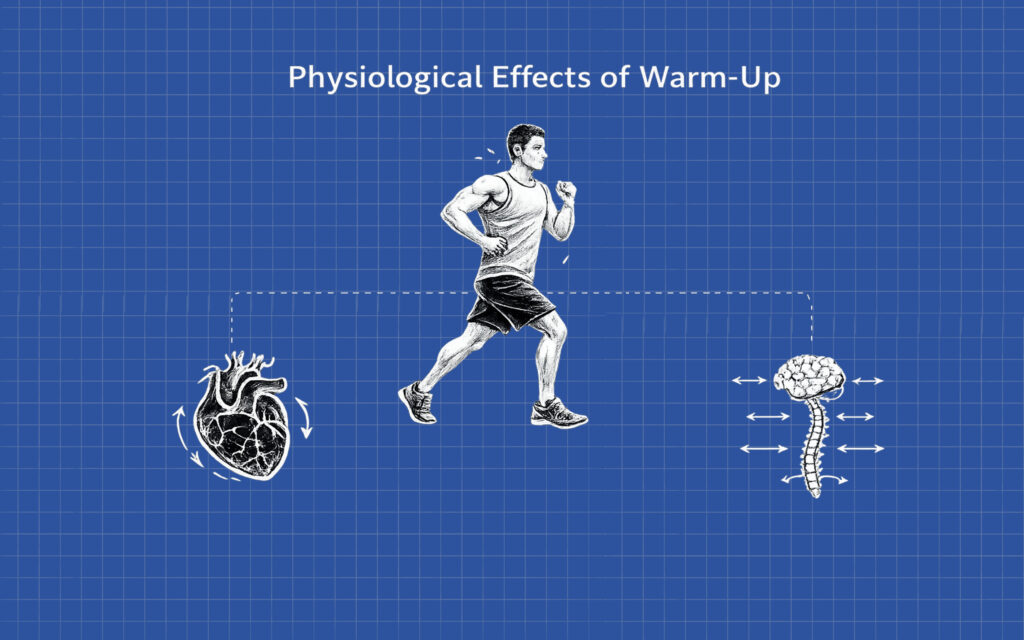
        Physiological Effects of Warm up

        Physiological Effects of Warm up

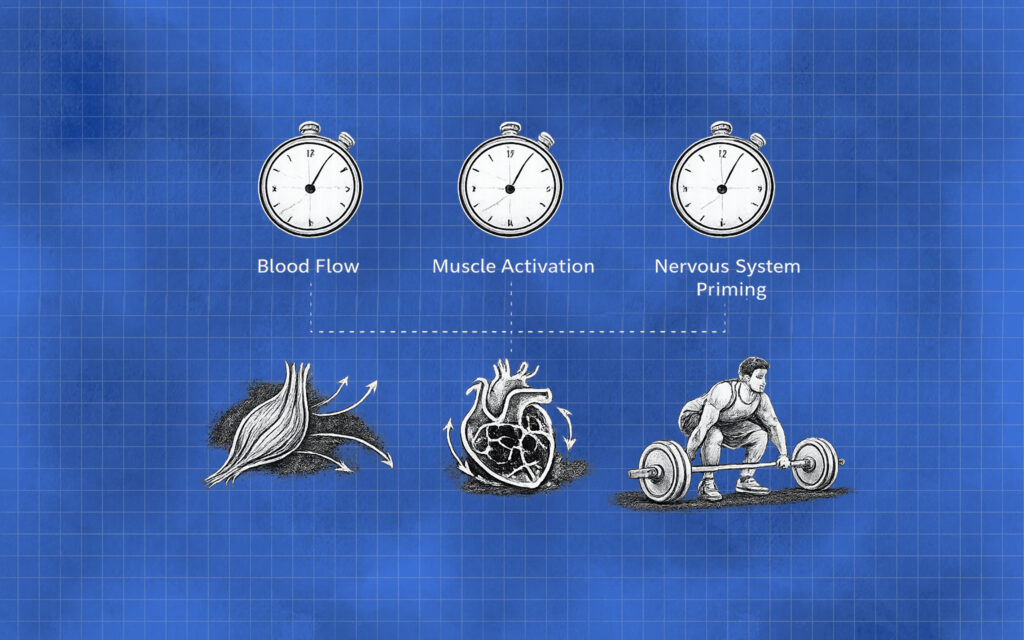
        Warm-ups are effective because they allow the nervous system, the joints, the muscles, and patterns of movements to work on a higher level. The correct warm-up produces a quick change within the body, which directly influences performance. Here is how your physiology responds to warm-ups:

        • Nervous System Activation
        • Raises the rate of motor neuron firing.
        • Enhances motor unit coordination.
        • Increases brain-to-muscle communication.

        This does not imply that muscles simply contract, but rather they contract at a higher rate, contract harder and more accurately. 

        Read Also: Do You Really Need to Warm Up Before a Workout? Yes – Here’s Why

        Takeaway

        Warm-ups not only safeguard you, but they also increase the ceiling of your performance. They stimulate the nervous system, improve joint mechanics, enhance instant strength and power, increase the efficiency of movement and help in making your workout easier and more powerful. So the next time you fill up your shakers with creatine or pre-workout and pick out your favourite fitness accessories, remember to also keep some buffer time for warm-up, your body will thank you. 

        The Problem With Chasing Burn

        Hello Ziddis! Do you recognise the feeling of an intense “burn” during a workout? It is often thought of as proof of a good session. But hurt can not be the right measure to understand if your workout is working for you. Muscle burn is a sensory response and not an indicator of muscle growth, fat loss or improvement in performance. Let us understand why burning, while it helps you train more, can be problematic.

        Chasing the Burn

        Muscle burn comes from a metabolic reaction, which leads to byproducts like hydrogen ions produced during high rates of glycolysis. These ions accumulate and then lower the muscle pH while stimulating the pain receptors. Here is how you can create the burn:

        • Using very light weights for more reps
        • Holding isometrics for long durations
        • Short rest periods between sets

          By increasing the discomfort, you can not guarantee sufficient mechanical tension, progressive overload or long-term adaptation. Instead, chasing burn more often than not leads to:

          • Sensations get more attention than progression
          • Avoiding heavier or more effective loads
          • Confusing fatigue with stimulus

            Burn feels intense, but the intensity of sensation does not mean an intense stimulus.

            Muscle Burn vs Fat Burn

            One of the most persistent myths about burn is that muscle burn means you are burning fat. These are two different concepts because muscle burn is local, as in it works inside the working muscle, while fat loss is systemic and is driven by energy balance over time.

            You might end up feeling an extreme burn in the muscle if you:

            • Burn many calories
            • Create a meaningful fat-loss signal
            • Increasing metabolic rate in the long run

              Fat loss depends more on:

              • Total training volume
              • Training consistency
              • Calorie expenditure in a day
              • Diet and recovery

                Workout Intensity Misconceptions

                The fitness world has tonnes of misconceptions followed as cardinal rules anb hence it gets important to do your own research.

                • Low-load, high-rep sets can create a massive burn while generating low mechanical tension, which can limit your strength and hypertrophy (muscle pump) outcome.
                • Burn tells you about metabolic stress, not effectiveness
                • Progress comes from overload, volume, consistency, and recovery
                • Effective training can feel uncomfortable or surprisingly calm
                • The absence of burn does not mean the absence of result

                  Cardio Burn vs Calories Burned

                  Cardio Burn vs Calories Burned

                  The burning sensation in your lungs and legs can mislead you into believing that it is working. What it means is that you are experiencing high burn during cardio because of:

                  • Poor pacing
                  • Inadequate aerobic base
                  • Rapid lactate accumulation

                    It does not mean:

                    • High calorie burn
                    • Better cardiovascular adaptation
                    • More fat loss

                      Steady, sustainable cardio with lower perceived burn can burn the same amount or even more calories over time because:

                      • It is a more sustainable approach
                      • It allows higher total work
                      • Recovery is faster
                      • It enables frequency

                        Read Also: Fat Burner Supplements: Do they Work, And are There Any Natural Alternatives?

                        Takeaway

                        Muscle burn is your body’s feedback, not a scoreboard for your workout. The burn tells you about metabolic stress and not its effectiveness. Train for measurable progression and don’t chase sensations. Fat burning can be accelerated by fat burner supplements and L Carnitine. Remember that burn is a feeling and results are earned over time.

                        The Real Reason Your Pre-Workout Stopped Working

                        Hello Ziddis! Have you started to feel like your pre-workout isn’t working out for you? It started with a bang and now feels like it has reached a plateau. “Maybe you got used to the formulation or caffeine” is an explanation not analysed. The real reason is a mix of neurobiology, formulation quality, dosing strategy and lifestyle drift. This is what affects performance and not just how hyped you feel.

                        Pre Workout Tolerance Break: What Tolerance Actually Means

                        Most people think tolerance means needing more scoops. But that is not the full picture. What really happens is:

                        • Caffeine blocks adenosine, the signal to get “tired”. When there is repeated exposure, your brain increases adenosine receptors, which means the same caffeine levels but lesser effects.
                        • Dopamine and norepinephrine spikes become smaller over time, reducing alertness and drive.
                        • Peripheral adaptation is when blood vessel responds, calcium is released in muscle fibres, and neural firing efficiency adapts.

                          Lifestyle Factors Affecting Pre Workout

                          You can have a perfect supplement and still feel no results after using them then there could be underlying reasons:

                          • Pre-workout doesn’t replace sleep; it only masks fatigue.
                          • Chronic sleep restriction reduces dopamine receptor sensitivity.
                          • High cortisol blunts the stimulant response.
                          • Your nervous system is being overstimulated; these can add more stimulants, but don’t translate to performance.
                          • The workout feels harder, but you are stronger.
                          • Low carbs make the pre-workout not work.
                          • Electrolyte imbalance can cause flat sessions.

                            How Often to Take Pre Workout (Frequency vs Dependence)

                            This isn’t about “daily vs not daily.” It is about what you need the pre-workout to do for you.

                            Use Daily if:

                            • Caffeine does moderate and consistently
                            • Non-stimulant performance ingredients are fully dosed

                              Don’t use daily if:

                              • The formula relies mostly on stimulants
                              • You escalate doses to feel something
                              • You expect motivation instead of performance support

                                Why Your Pre Workout Feels Weaker

                                Why Your Pre Workout Feels Weaker (Beyond Tolerance)

                                Many formulas feel like they give you energy without actually giving you any real energy. This is perceived energy and feels like a real usable one. How to figure it out? Watch out for signs of:

                                • Tingling
                                • Buzz
                                • Increased heart rate
                                • Feeling pumped up

                                  So when tolerance reduces the buzz, you imagine that the product has stopped working. The performance never actually changed. It was just that now you were not able to perceive the energy.

                                  Sometimes your pre-workout feels weaker because:

                                  • There is a reduced ingredient quantity
                                  • It uses blends that sound great but are actually basic
                                  • Your body adapts, and these bare minimum dosages stop feeling effective.

                                    How to Reset Pre-Workout Tolerance (Without Just Quitting Caffeine)

                                    The real reset is not supposed to feel dramatic and extreme. Let’s chalk down the strategy:

                                    • Step 1: Lower the stimulant ceiling
                                    • Step 2: Focus on ingredients that improve your blood flow, neural drive and muscle contraction ability.
                                    • Step 3: Change timing, not just dose by using pre-workout only for heavy days or intense sessions. This will prevent the pre-workout from feeling like a regular thing.
                                    • Step 4: Fix your lifestyle elements such as sleep, carb intake, sodium levels and stress management.

                                    Read Also: Making the Perfect Pre Workout Meal for an Impactful Workout

                                    Takeaway

                                    If the pre-workout has stopped doing its thing for you, it does not always mean that your body has grown used to caffeine. Your choice of supplements and protein powder will also determine this. BCAA supplements are getting all the hype for good reason, so give them a shot if you are getting serious about your fitness. The goal is to feel and perform better even if you don’t feel the gush of energy that subsides sooner than it set it. The goal is to feel and perform better even if you don’t feel the gush of energy that subsides sooner than it set it.

                                    Proprietary Blends vs Fully Dosed Formulas: The Real Difference

                                    Hello Ziddis! Almost every walk down the supplement aisle is a war of labels. Time against you, prices incomparable and ingredients confusing. Some list every ingredient with exact weight, while others just scatter information under a single name. In between all this hassle, you’d end up reading “proprietary blends” and “fully dosed formulas”. Let us understand what each means so you can make the smart choice in the supplement aisle!

                                    Proprietary Blends

                                    A proprietary blend is a mixture of ingredients listed under one collective name, where the total weight of the blend is disclosed, but the individual ingredient dosages are not. For example, ifthe  label says: Proprietary energy blend- 5,000 mg

                                    Caffeine, Beta-Alanine, L-Tyrosine, Taurine

                                    This means that the ingredients are listed in descending order by weight but the exact weight of each is not mentioned.

                                    Why do brands use proprietary blends then if the weight is not specified?

                                    • Prevent competitors from copying the formula exactly
                                    • Allowing the brand to tweak ingredients for any advanced formulation and ratio without having to make changes on the labels.
                                    • Simplifying marketing because the “one blend” concept sounds cleaner than a long list of ingredients.

                                      Fully Dosed Formula

                                      A fully dosed formula lists down every ingredient with its exact amount on the label for all to understand. For example, a label of a fully dosed formula would look like:

                                      • Beta-Alanine- 3,200 mg
                                      • L-Citrulline- 6,000 mg
                                      • Caffeine- 200 mg
                                      • L-Tyrosine- 1,000 mg

                                      This approach allows users to compare dosages against evidence-backed ranges used in clinical research. What it means for all is:

                                      Matching ingredients to scientifically supported doses

                                      • Predicting how the product is likely to feel and perform
                                      • Adjusting intake based on tolerance, goals and training load
                                      • Stacking intelligently without accidental overdosing

                                        Pros and Cons of Proprietary Blends

                                        ProsCons
                                        Can protect unique formulationsImpossible to know if key ingredients are underdosed or overdosed
                                        Allows smoother and subtler effects for everyoneDifficult to compare products objectively
                                        Simpler for beginnersHarder to manage caffeine, stimulants or cumulative intake
                                        Does not overwhelm anyoneReduces transparency, which can impact long-term consumer trust

                                        Difference Between Proprietary Blend and Fully Dosed

                                        AspectProprietary BlendFully Dosed Formula
                                        Ingredient transparencyPartialFull
                                        Dose verificationNot possibleEasy
                                        PredictabilityLowHigh
                                        Stacking compatibilityRiskyControlled
                                        Consumer educationLimitedStrong

                                        Read Also: Why “No Crash” Is a Key Buying Phrase

                                        Takeaway

                                        Proprietary blends aren’t bad at the core; they are just not as transparent as fully dosed formulas. Most gym supplements follow clear guidelines of what is acceptable, but are not obliged to reveal the exact formula on packaging. So the next time you are wandering confused in the supplements aisle, looking for the right creatine, know that not revealing the formulation isn’t necessarily bad, but if you need more clarity, go for fully dosed ones!

                                        How Surface Choice Affects Joint Load

                                        Hello Ziddis! Did you know? The surface you run on or train on plays an important role in how much stress your joints endure during the training. Every step sends force up from the ground through your feet, ankles, knees, hips and spine. Surface hardness, energy return and stability all determine whether that force is absorbed, redirected or amplified. You need to choose the right surface to train on so you can match it to your training goal.

                                        Joint Load Running

                                        Joint load simply means the mechanical stress that joints experience with each foot strike. When you run, the ground’s reaction force can reach you at 2 to 3 times your body weight, and the surface you run on can affect how these forces are distributed. Some factors that play a role in affecting joint load are:

                                        • Surface stiffness- how much the ground deforms on impact
                                        • Energy return- how much force is returned or absorbed
                                        • Stability- how predictable the landing surface is

                                          Higher joint load doesn’t always mean “bad”, but unmanaged load over time increases the risk of getting injured.

                                          Running Surface Impact

                                          Let us understand how different running surfaces impact the joint load

                                          Surface TypeHow It Impacts the BodyImpact on Joints
                                          Hard surfaces (concrete, asphalt)Minimal shock absorptionHigher impact force transmissionConsistent and predictable foot strikesGreater stress on the knees, hips, and lower back can aggravate existing joint or bone issues
                                          Soft surfaces (grass, dirt, track)More impact absorption Lower peak joint forces Slightly higher muscular demandReduced joint stress per step, especially helpful during recovery phases
                                          Uneven surfaces (trails, sand, gravel)Variable impact angles Increased stabiliser muscle activationLower repetitive impact due to unpredictabilityLess repetitive joint loading, but higher risk to ankles, heels, and knees if the body is unprepared

                                          Concrete vs Asphalt Running

                                          Both concrete and asphalt come under hard surfaces, but there are some differences that make each have its merits and cons.

                                          1. Concrete:

                                          • Extremely rigid
                                          • Higher impact stress
                                          • More demanding on joints

                                          2. Asphalt:

                                          • Slightly more flexible than concrete
                                          • Better shock absorbent
                                          • Better for road running

                                              If joint pain is a concern, asphalt is a better option than concrete track.

                                              Best Running Surface for Joints

                                              There is no one single “best” surface for you to run. The best one is the one that helps you achieve your goals.

                                              • For recovery runs, grass and dirt trails are helpful for a lower joint stress experience and faster recovery.
                                              • For base mileage, a mix of asphalt and softer surfaces helps balance durability and joint health
                                              • For speed and preparing for a race, an asphalt track is better.
                                              • For joint sensitivity or being cautious of injuries, softer, flatter surfaces can help by avoiding sudden spikes.

                                                Read Also: How Shoes Change Impact Forces Through the Legs

                                                Takeaway

                                                Your surface choice directly affects how much stress your joints absorb and how well you recover from it. Hard surfaces boost performance but increase joint load, whereas the soft ones protect against joint load. Gear up in your activewear or tank tops and let’s get ready to run!