




Shoulder Workout: 10 Best Exercises for Bigger, Stronger Shoulders (2026 Guide)

Key Takeaways
Beginner Shoulder Workout: A lower-volume, 4-exercise routine using dumbbells and machines designed to build a foundational base without overtraining.
- Intermediate Gym Workout: A comprehensive 5-exercise routine utilizing barbells and cables, built for experienced lifters to push heavy compound weights and hit all three delt heads.
- At-Home Workout: A 4-exercise, dumbbell-only routine specifically designed for lifters who want full shoulder development without access to a gym.
Most lifters over-train the front delts with endless pressing and rarely hit the side and rear heads. And that’s why shoulders stay narrow, no matter how hard you push. This guide will fix that for you, it covers the 10 best shoulder exercises by deltoid head, three workout routines designed for the gym or home, and a simple system for sets, reps, and frequency.
A good shoulder workout trains all three deltoid heads, not just the front deltoid. The overhead press is the best compound movement because it loads the whole shoulder and develops pressing strength. Lateral raises and rear delt flys are the two most neglected isolation moves – lateral raises build width by working the side (medial) delt, and rear delt flys balance the shoulder and support posture. Hit shoulders twice a week for a total of 12-20 sets over all three heads. A simple template. One heavy press, two side-delt exercises, one rear-delt exercise, rotated every few weeks .
Shoulder Anatomy: What You’re Actually Training
The deltoid isn’t one muscle – it’s three separate heads, and most shoulder workouts only train one of them well.
Anterior (Front) Delt
This is the head that presses. It fires hard on overhead presses, push-ups, and any pushing movement. Most gym-goers over-train this head without realizing it, since chest day already works it too.
Lateral (Side) Delt
This head extends the arm to the side. It’s what develops shoulder width, the “cap” look, and it responds best to lateral raises, not presses.
Posterior (Rear) Delt
This head pulls your arm backward. It helps with posture and shoulder balance and is the most commonly skipped head in a typical routine.
Two supporting structures are important too: The rotator cuff is a group of small muscles that help stabilize the shoulder and are prone to injury when heavily loaded. The trapezius muscle helps with overhead movement and can compensate for weak delts.
Key takeaway: Most shoulder routines are front-delt routines in disguise. Presses hit the front delt directly, and it also gets worked on chest day. The side delt is what gives you width and the rear delt balances the shoulder and protects your posture. If you want shoulders that look wider, not just “more pressed,” give lateral raises and rear delt work the same priority as your overhead press, not leftover sets at the end of the session.
The 10 Best Shoulder Exercises: Shoulder Workouts Guide
These 10 shoulder exercises are organized by delt head targeted, so you can build a balanced shoulder instead of just a bigger front delt. First compound presses, then isolation work for width and posture –
Compound Presses (Front Delt + Overall Mass)
1. Barbell Overhead Press
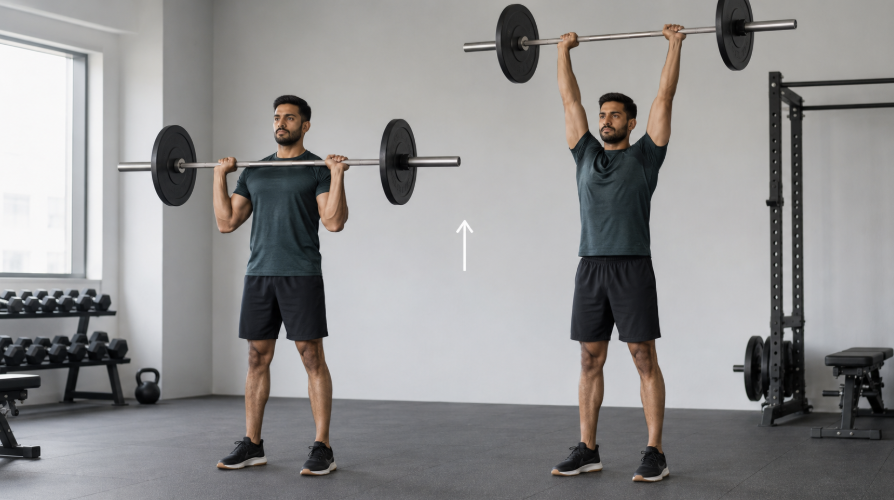
Targets: Anterior delt, with strong lateral and posterior involvement.
How to do it: This is the classic shoulder lift exercise, it loads bigger total muscle mass than any other move on this list. Stand tall, tighten your core, and press the bar straight overhead without leaning back. The common mistake is to flare the elbows too wide, taking the load off the shoulder and onto the traps.
Sets × reps: 3 – 4 × 6 – 10.
At-Home Alternative: Standing dumbbell shoulder press works the same pattern with less spinal loading.
2. Seated Dumbbell Shoulder Press
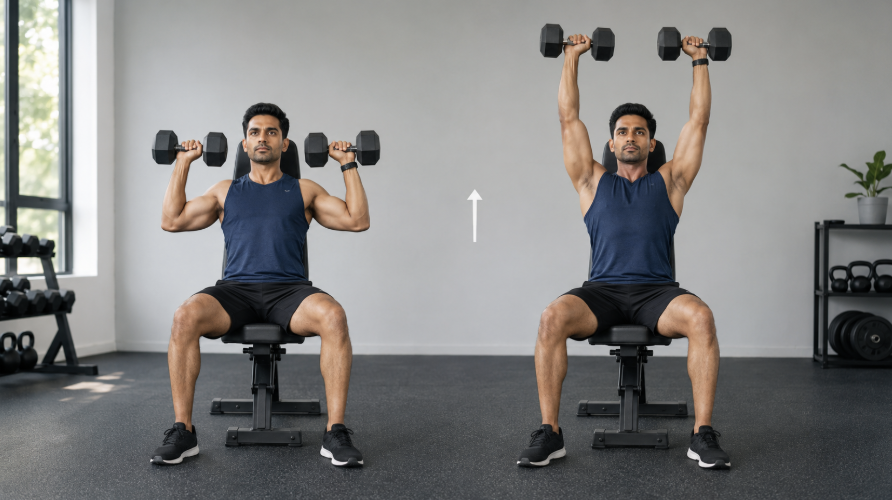
Targets: Anterior and lateral deltoid.
How to do it: Dumbbells allow each arm to follow a natural path, which is easier on the shoulder joint than a fixed path of a barbell. Press up with your back on the pad without locking out hard, and don’t arch to finish the last few reps.
Sets × reps: 3 × 8 – 12.
At-Home Alternative: If you don’t have a bench, do it standing, which also adds core work.
3. Arnold Press
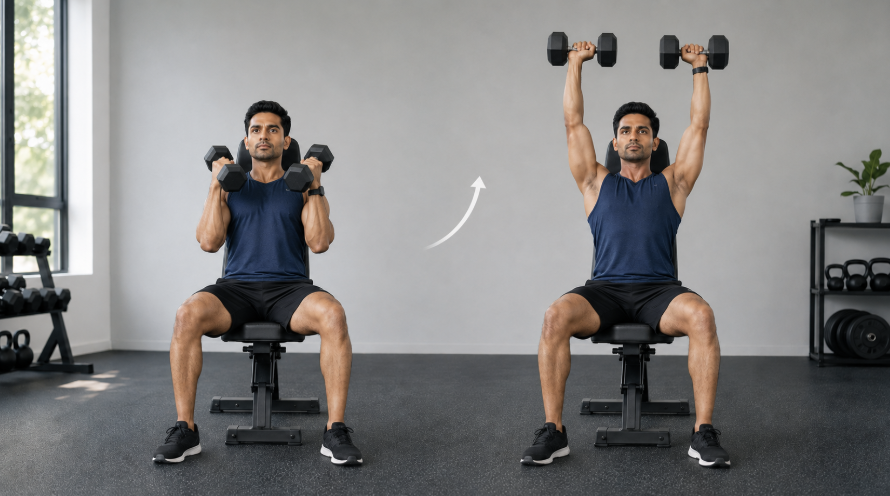
Targets: All three delt heads with extra rotational work for the anterior head.
How to do it: The rotating path – palms facing you at the bottom, facing forward at the top recruits more of the shoulder through a longer range than a standard press. Slowly rotate and don’t rush the twist. The usual mistake is to turn it into a fast, sloppy press.
Sets × reps: 3 × 10 – 12.
At-Home Alternative: Needs nothing but a pair of dumbbells, so it’s already home-friendly.
Side-Delt Exercises (Width)
4. Dumbbell Lateral Raise
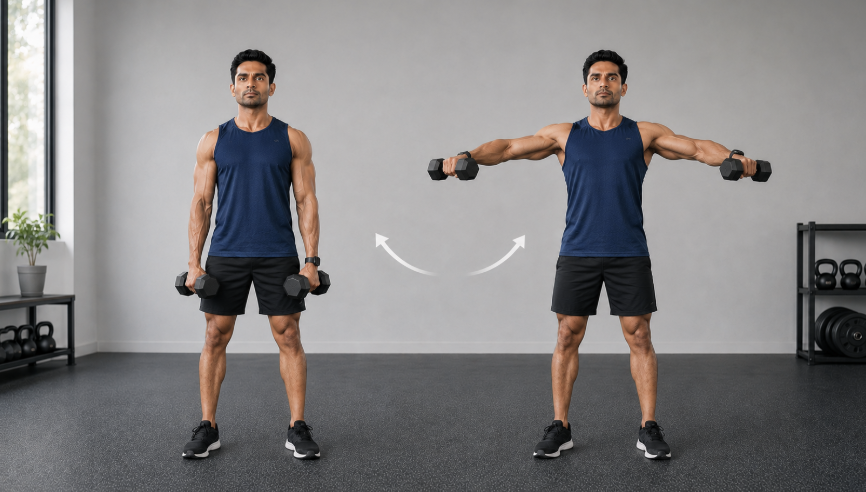
Targets: Lateral delt, single biggest driver of shoulder width.
How to do it: This is the move most people get wrong, swinging too much weight. Lead with your elbows, not your hands, and lift with a slight elbow bend to just below shoulder height. The usual mistake is to substitute momentum for control. In an EMG study comparing shoulder exercises, the lateral raise elicited the greatest medial and posterior deltoid activation of the exercises tested, followed by the shoulder press, bench press and dumbbell fly.
Sets × reps: 3 – 4 × 12 – 15.
At-Home Alternative: No adjustment needed – this is a dumbbell staple.
5. Cable Lateral Raise
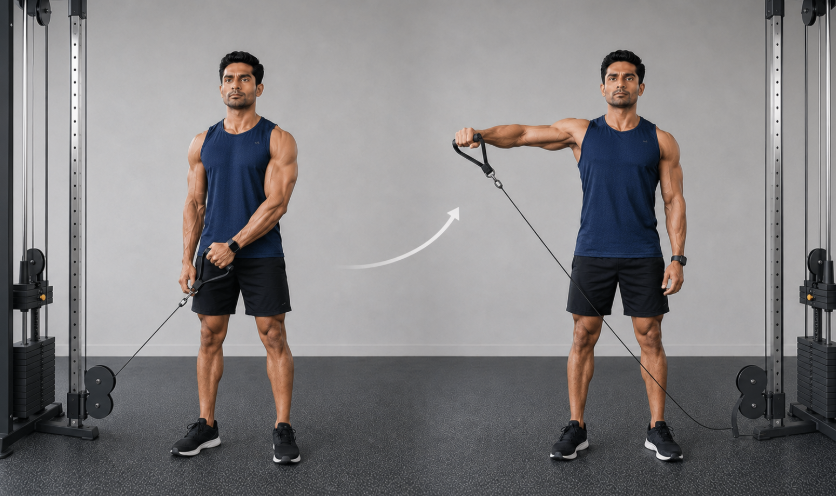
Targets: Lateral delt, with constant tension through the full range.
How to do it: Unlike dumbbells, cables maintain tension on the side delt even at the bottom of the move, where dumbbells go slack. Lift with a slight bend in the elbow standing side on to the cable stack.
Sets × reps: 3 × 12 – 15 per side.
At-Home Alternative: A resistance band placed low under your foot gives the same constant tension.
6. Upright Row
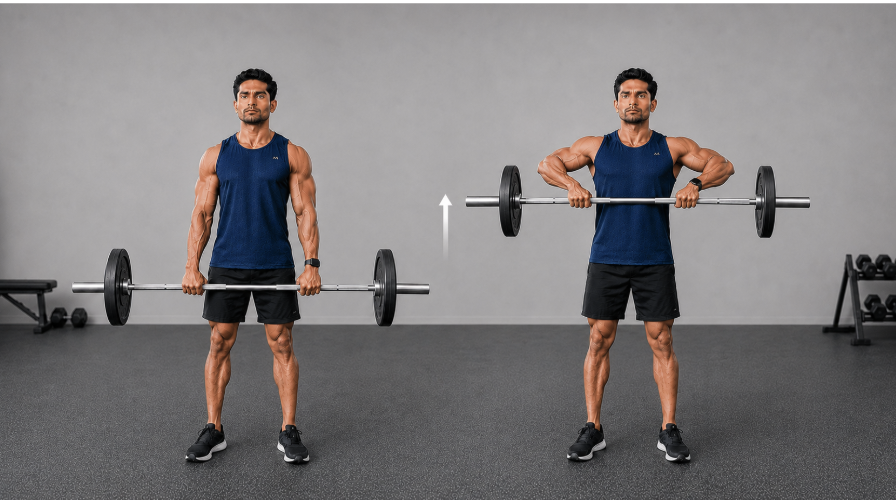
Targets: Lateral delt and upper traps.
How to do it: This exercise builds width fast, but needs a joint-friendly path. Lift the bar or dumbbells to about chest level, not chin level keeping the elbows just below the wrists. The usual mistake is pulling too high, which can pinch the shoulder joint.
Sets × reps: 3 × 10 – 12.
At-Home Alternative: Use a resistance band in the same way as a barbell here.
Rear-Delt Exercises (Posture & Balance)
7. Rear Delt Fly
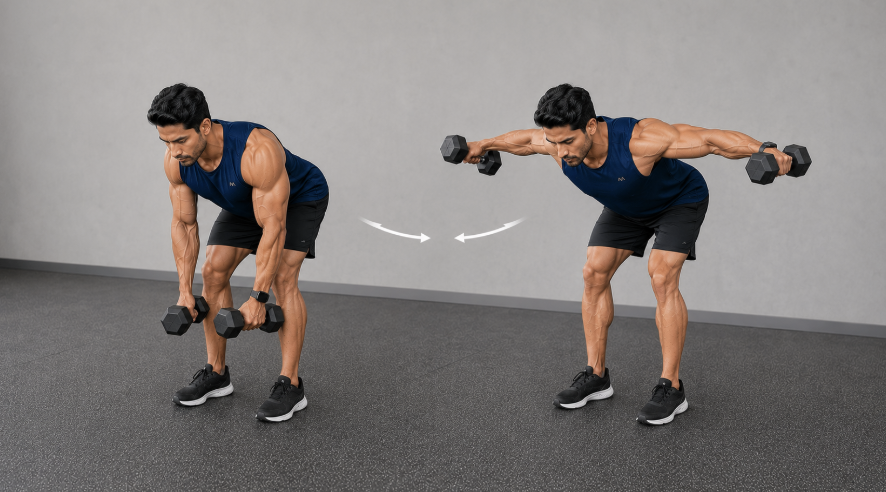
Targets: Posterior delt, the most commonly neglected head.
How to do it: Bend at your waist and raise the dumbbells out to the sides in a wide arc, squeezing your shoulder blades together at the top. The common mistake is to use too much weight and make it into a row.
Sets × reps: 3 × 12 – 15.
At-Home Alternative: Works equally well seated on the edge of a chair, holding dumbbells.
8. Face Pull
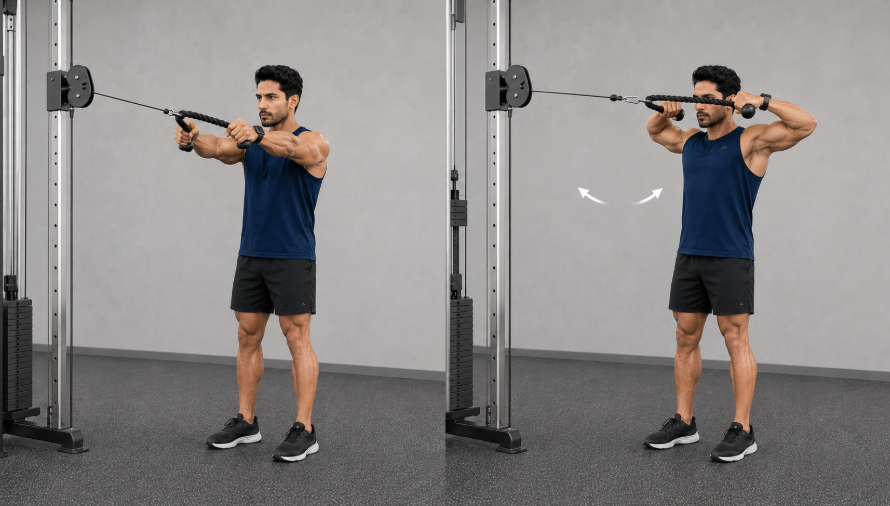
Targets: Posterior delt and rotator cuff.
How to do it: This is about as close to a “corrective” exercise on this list as you’re going to get, building the rear delt while actively protecting the shoulder joint. Draw the rope toward your face, keeping your elbows high, and hold for a second at the top.
Sets × reps: 3 × 15 – 20.
At-Home Alternative: A loop of resistance band anchored to a door closely mimics the cable path.
Front-Delt & Stability Work
9. Front Raise
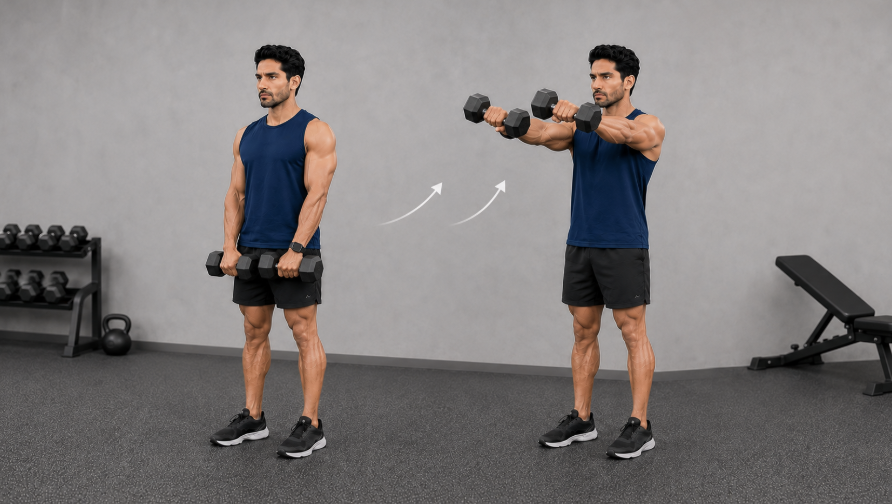
Targets: Anterior delt.
How to do it: A direct isolated front delt hit – great for lifters wanting to finish off pressing volume without adding more heavy compound work. Raise to about eye level and don’t swing the torso.
Sets × reps: 2 – 3 × 12 – 15.
At-Home Alternative: You can do this exercise with any dumbbell or even a filled backpack.
10. Landmine Press (or Rotator-Cuff External Rotation)
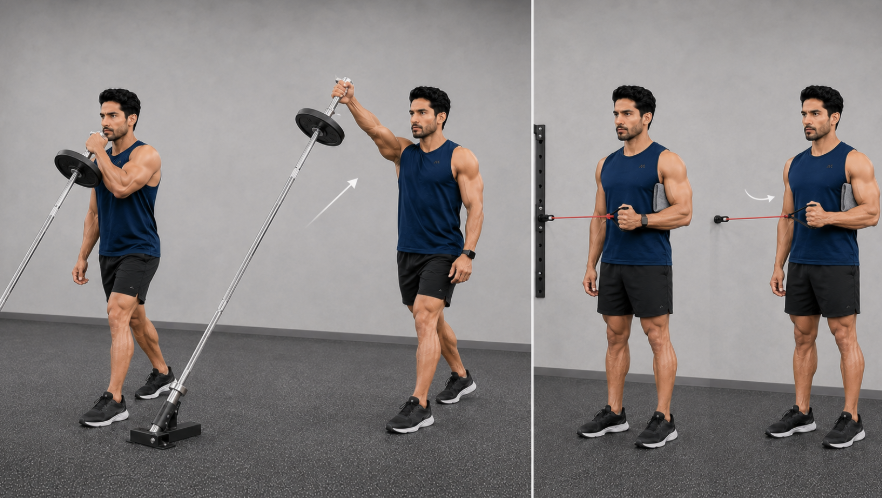
Targets: Anterior delt with a shoulder friendly angled path. The external rotation variant targets the rotator cuff directly.
How to do it: The landmine’s angled bar path is easier on sore shoulders than a straight overhead press, making it a good swap for lifters with shoulder discomfort. As an optional finisher, light rotator-cuff external rotations with a band work on joint stability rather than size.
Sets × reps: 3 × 10 – 12 (landmine) or 2 × 15 (external rotation).
At-Home Alternative: A single dumbbell pressed from the chest at an angle is a close approximation of the landmine pattern.
Rep ranges above follow standard hypertrophy dosing; see the programming section below for how weekly volume across these moves affects growth.
Sample Shoulder Workout Routines
A list of exercises only helps if you know how to put them together. Here are three ready-to-run routines, pick the one that matches your setup and experience.
Beginner Shoulder Workout
Four moves, dumbbell and machine-friendly, at a lower total volume to build a base without overreaching.
| Exercise | Sets × Reps | Rest |
| Seated Dumbbell Shoulder Press | 3 × 10 – 12 | 90 sec |
| Dumbbell Lateral Raise | 3 × 12 – 15 | 60 sec |
| Rear Delt Fly | 3 × 12 – 15 | 60 sec |
| Face Pull | 2 × 15 – 20 | 45 sec |
Gym Shoulder Day (Intermediate)
Five moves hitting all three heads, compound lifts first, isolation and prehab last.
| Exercise | Sets × Reps | Rest |
| Barbell Overhead Press | 4 × 6 – 10 | 2 min |
| Cable Lateral Raise | 3 × 12 – 15 | 60 sec |
| Upright Row | 3 × 10 – 12 | 90 sec |
| Rear Delt Fly | 3 × 12 – 15 | 60 sec |
| Face Pull | 3 × 15 – 20 | 45 sec |
At-Home Dumbbell Shoulder Workout
Four moves, dumbbells only -built for readers without gym access.
| Exercise | Sets × Reps | Rest |
| Arnold Press | 3 × 10 – 12 | 90 sec |
| Dumbbell Lateral Raise | 3 – 4 × 12 – 15 | 60 sec |
| Rear Delt Fly (seated) | 3 × 12 – 15 | 60 sec |
| Front Raise | 2 – 3 × 12 – 15 | 45 sec |
How to Program: Sets, Reps, Frequency & Progressive Overload
How Many Sets Per Week
Aim for around 12 to 20 total sets per week for all three delt heads. In a 2022 systematic review of resistance training volume, this range was found to be an optimal standard for hypertrophy in trained lifters. The most important thing is your total weekly volume, not how many separate “shoulder days” you schedule.
Reps & Load
For most of the exercises above, an 8 – 12 rep hypertrophy range at about 70 – 80% of your one rep max builds size well. Save heavier, lower-rep work (4 – 6 reps) for compound presses such as the barbell overhead press, and save isolation moves like lateral raises in the 12 – 15 rep zone.
Frequency
If volume is equal, training your shoulders twice a week is usually better than once. Remember, your delts get indirect work on chest and back day, so factor that into your weekly total to prevent overtraining.
Progressive Overload
Growth stalls the moment your training stops getting harder. Add a rep, add a little weight, add a set. Pick one variable and push it from session to session. Without it, even the best list of workouts won’t build size.
Warm-Up, Rotator-Cuff Prehab & Cool-Down
5-Minute Warm-Up
Start every shoulder session with dynamic movement, not static stretching. Arm circles, band pull-aparts and banded external rotations increase blood flow and prepare the joint for load. Long term improvements in strength and power output have been shown to be more beneficial using a dynamic-stretching warm-up protocol as opposed to a static-stretching warm-up. (Herman & Smith, 2008, J Strength Cond Res -PMID: 18545176).
Protect Your Rotator Cuff
The shoulder is the most injury-prone joint in the gym because it gives up stability for range of motion. Light external-rotation work with a band for 10-15 reps before your main lifts will build resilience in those small stabilizing muscles that heavy pressing doesn’t hit.
Post-Workout Stretches
Finish with a cross body shoulder stretch, a triceps stretch overhead, and a short child’s pose to open the upper back. Hold for 20-30 seconds each with no bouncing
Recovery & Nutrition for Shoulder Growth
Shoulders don’t grow in the gym – they grow during recovery, when adequate protein and rest let the muscle rebuild bigger than before.
For most exercising adults, a daily protein intake of roughly 1.4 – 2.0 g per kg of bodyweight is enough to build and maintain muscle, as per the International Society of Sports Nutrition’s position standards; the same review notes that resistance-trained lifters cutting calories may benefit from intakes toward the higher end of that range. Many vegetarian diets in India fall 20 – 40 g short of target on training days, which is where a whey protein guide can help close the gap.
Creatine is another well-studied option worth considering alongside training – see this creatine dosage guide for beginners for how it supports strength and recovery.
One honest caveat: supplements are only gap fillers. They are not a replacement for your training volume, sleep or your total daily protein intake.
Save this routine and start with the beginner or home version this week. And if your daily protein intake is falling short, a MuscleBlaze whey can help close that gap.